Winema (ca. 1848-1932)
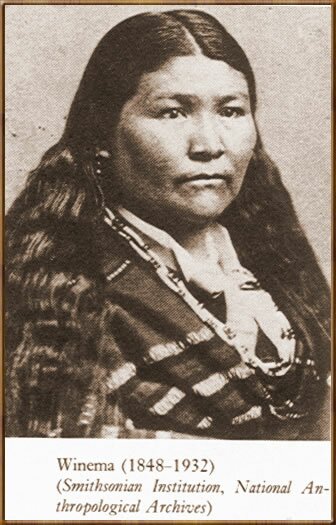
Kaitchkona Winema, "The Storng Hearted Woman,"or less accurately, "The Little Woman Chief,"from the Modoc kitchkani laki shnawedsh, "female subchief,"was an important figure on the Modoc War of 1872-1873, and in other affairs of her tribe. The name Winema was apparently applied by Joaquin Miller. Born on the Link River in northern California in September 1848, she was early known as Nonooktowa, the "Strange Child"; her farther was a Modoc man named Secot, but her mother's name is not recorded. Her early life was adventurous, and her fearless exploits, such as shooting a grizzly bear and fighting alongside the men in battle, were greatly admired. She seems to have been something of a tomboy, and once when she and some other girls who were canoeing got caught in the rapids, Winema manipulated the canoe brilliantly and all were saved. In late youth she fell in love with, and eventually married, a White miner from Kentucky named Frank Riddle, and the admiration of her people turned to scorn; only her brother Kintpuash and a warrior named Scarface Charlie remained loyal to her. Following her marriage she became known familiarly to Whites as Toby Riddle.
The 1860's saw growing friction between the Modoc people and the White Settlers moving into northern California in ever-increasing numbers. Winema served as an interpreter, with her husband, in the negotiations between the government and the Modoc which shortly led to the removal of the Indians to a reservation in Oregon. Many of the Modoc never agreed willingly to t his move, and Kintpuash and a group of followers frequently left the reservation to return to their traditional homelands. When they were finally pursued by government forces in an effort to round up the band and end the intermittent resistance, they fled to the nearby lava beds. Winema tried to act as a peacemaker between the warring parties, since she was trusted by both sides, and was fluent in Modoc and English. In February 1873, a peace commission attempted to resolve the situation and Winema was able to persuade Kintpuash to meet with them. However, other Modoc opposed the move, and convinced Kintpuash that the leader of the delegation, General Edward Canby, could not be trusted and must be killed.
Winema learned of the plot, and warned Canby, but he decided to go ahead with the peace talks. On April 11, 1873, Kintpuash and several warriors attached the camp, and killed Canby and another commissioner, Eleazar Thomas; a third commissioner, Albert Meacham, was badly injured, but Winema intervened and saved his life. With these murders, all-out war began, and although the Modoc held off the vastly superior Army forces for many months, they were finally defeated. Kintpuash and five other leaders were tried, convicted, and executed. Meacham, still a champion for the Indian position in spited of the attach upon him, took the story East in the form of a lecture-play entitled Winema; this play told of the War and reasons which led to the uprising. The troupe included Winema, Frank Riddle, and their son Jeff, and several other Modoc participants and toured during 1874 - 1881.
Following the successful tour of the group, Winema returned to Oregon where she lived quietly for many years. She died on the reservation on May 30, 1932, and was buried in the Modoc Cemetery. The Winema National Forest is named for her.
|


 NATIVE AMERICAN RHYMES