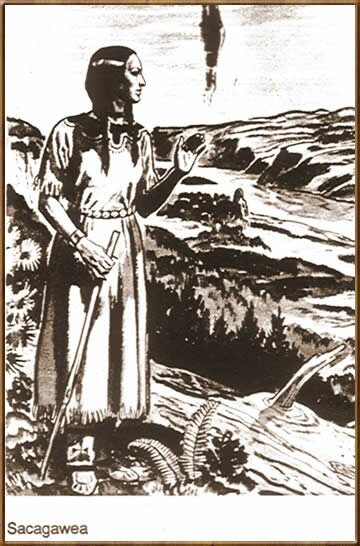
Sacajawea (more accurately Sacagawea), from Hidatsa (?) tsakakawia, "Bird Woman," was an interpreter and the only woman on the Lewis and Clark Expedition of 1804-0806. She was born into the Shoshoni tribe in the Rocky Mountains. The exact date has been variously reported as 1784 and 1788. Her Shoshoni name was Boinaiv, meaning "Grass Maiden". The matter of an accurate rendition of the name by which she is popularly known has long been a matter of argument. Today, an exact translation is impossible; a more accurate meaning seems to be "Boat Traveler," a reference to her appearance in the longboats which were being dragged through the shallows. In an effort to indicate the use of long oars, the tribe flapped their arms; Clark thought this meant birds or "Bird Women", hence the name which has come into common use.
Around the age of 12, Boinaiv was captured by some Crow warriors and sold to the Hidatsa on the Missouri River in North Dakota. Then she and another Native American girl were sold to a French-Canadian fur trader, Toussaint Charbonneau, who married them both. In 1804 Lewis and Clark hired him as a guide and interpreter for their western journey. Charbonneau took Sacajawea and her newborn baby, Baptiste, along; she proved to be a valuable intermediary between the explorers and the several native tribes they encountered, particularly in view of her knowledge of the Shoshoni language. When the expedition came to the Rockies and her home village, she had a joyous reunion with her people, and especially with her brother, now chief, Cameahwait, who greeted he as Wadze-wipe, Lost Women." This relationship was particularly helpful to the party. Although Cameahwait was initially hostile, intending to kill the Whites for their goods, he was dissuaded by the intercession of his sister, and eventually was willing to provide horses and supplies to the expedition in barter. At this time, Sacajawea adopted the son of her dead sister and named him Basil.
Sacajawea, as she was known by now (Lewis called her "Jenny" throughout his journal) accompanied the expedition across the Rockies and down the Columbia River to the Pacific, arriving there on November 7, 1805. Both Lewis and Clark testified to her fortitude, endurance and serenity; Clark was especially fond of her and her son. Eventually he transported the Charbonneau family to St. Louis in 1809 and helped them to set up a farm. In 1811 they left their son Baptiste with Clark, to return west with an expedition led by Manual Lisa; Clark adopted the son as his own.
The death of Sacajawea remains one of history's great mysteries. One account records Lissa'a clerk thusly: "This evening (December 12, 1812) the Wife of Charbonneau, a Snake Squaw, died&aged about 25 years." However, some other sources indicate that Sacajawea spent most of her life with her own people, moving with them to the Wind River Reservation and finally dying at Fort Washakie on April 9, 1884, aged about 100 years. In an effort to settle the question, Commissioner Charles H. Burke dispatched Inspector Charles A. Eastman (Ohiyesa) to locate the burial place. In a report sent to Burke on March 2, 1925, Eastman reported that he had interviewed many surviving people, had found the site and felt that it was indeed the resting place of "the real Sacajawea." However, at the present writing, the 1812 date seems to have stronger support.
Whatever the truth, and this may never be conclusively proven, that is no doubt that Sacajawea was a major key to the success of the Lewis and Clark Expedition. Her role, however, has been less clearly perceived; she was not a guide, as is often claimed. Rather, she was particularly effective in providing help through he interpreting services with the tribes along the way - serving, as Lewis put it, as "&the inspiration, the genius of the occasion." She has been honored with many plaques and monuments throughout the Western States.
Source: Great North American Indians by Frederick J. Dockstader


 NATIVE AMERICAN RHYMES