LaDonna Harris (Comanche)
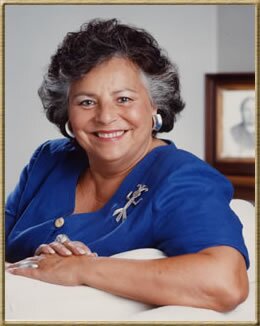
LaDonna Harris, President of Americans for Indian Opportunity, is a remarkable statesman and national leader who has enriched the lives of thousands. She has devoted her life to building coalitions that create change. She has been a consistent and ardent advocate on behalf of Tribal America. In addition, she continues her activism in the areas of civil rights, environmental protection, the women's movement and world peace.
Raised in Indian country on a farm near the small town of Walters, Oklahoma during the Great Depression by her maternal grandparents (an Eagle Medicine Man and a devout Christian woman), Harris modeled a life and career of mutual respect and personal choice and has an abiding belief that there is room for all traditions. Because she spoke only Comanche when she entered grade school and because of her unique upbringing, Harris views all things with the wisdom and values of two cultures.
Harris began her public service as the wife of U.S. Senator, Fred Harris. Her partnership with Senator Harris made her a strong force in Congress where she was the first Senator's wife to testify before a Congressional committee. She was instrumental in the return of the Taos Blue Lake to the people of Taos Pueblo and to the Menominee Tribe in regaining their federal recognition. Her guiding influence on both pieces of legislation led to landmark laws that set a precedent that still guides Indian policy today.
For more than 3 decades, Harris has been a strong voice for Native American rights. In the 1960's, she founded Oklahomans for Indian Opportunity to find ways to reverse the stifling socio-economic conditions that impact Indian communities. Today, this organization remains vital, serving the tribes of Oklahoma . From the 1970's to the present, she has presided over Americans for Indian Opportunity. A catalyst for new concepts and opportunities for Indian peoples, this national organization works to enhance the cultural, social, political and economic self-sufficiency of tribes. Harris also founded some of today's leading national Indian organizations including the National Indian Housing Council, Council of Energy Resource Tribes, National Tribal Environmental Council, and National Indian Business Association.
Harris applies much of her energy to reinforcing and strengthening tribal governments. She has encouraged tribes to reweave traditional value based methods of consensus building into their governance systems. She has worked directly with the Winnebago, Poarch Band Creek , Oklahoma Apache, Cheyenne-Arapaho, Comanche, Pawnee, and Menominee tribes in assessing how these tribes can reincorporate traditional dispute resolution methodologies into contemporary systems of government. "Tribal Issues Management System," the process used to facilitate dialogue, was developed by Harris and has been used to facilitate resolution throughout the country and in two international forums. Harris believes that as cultural groups throughout the world struggle for autonomy and as tribal and ethnic strife become the focus of unrest on nearly every continent, Tribal America has a unique opportunity to make a positive contribution to our global society.
Harris has spent many years training the executive branch of the federal government regarding tribes'unique role in the U.S. Federal system. She has held hundreds of forums on the issues surrounding the intergovernmental interaction between tribes and federal agencies. She has published significant papers, including, To Govern or Be Governed: Indian Tribes at a Crossroads, Partnerships for the Protection of Tribal Environments, Indian Business Opportunities and the Defense Sector, Alternatives for Agriculture: Successful Tribal Farms, Hard Choices: Development of Non-Energy Non-Replenishable Resources, and Tribal Governments in the U.S. Federal System . In the 1980's, Harris was instrumental in the adoption of official Indian policies by the Environmental Protection Agency, the Department of Energy, and the Department of Agriculture.
In helping tribes plan for the future, Harris recognizes the significance of the Information Age and the impact computer technology will have on tribal communities. She has created the first Indian owned and operated computer telecommunications network - INDIANnet -- dedicated to establishing and developing free public access to electronic information and communication services for Native Americans. The early 1990's, Vice President Gore recognized Harris as a leader in the area of telecommunications in his remarks at the White House Tribal Summit and then Secretary of Commerce Ron Brown appointed her to the Advisory Council on the National Information Infrastructure.
Harris is most proud of the very successful national Indian leadership training initiative she help to develop, the Ambassadors Program. Based on her past work with tribal governments and using traditional tribal values and perspectives as a foundation, this special Program is designed to empower a new generation of Native American leaders to meet the challenges of the 21 st Century. This project is a fitting legacy to Harris' devotion to strengthening tribal governments and gives Tribal America a new cadre of leaders blessed by her spirit.
As a national leader, Harris has influenced the agendas of the civil rights, feminist, environmental and world peace movements. She was a founding member of Common Cause and the National Urban Coalition and is an ardent spokesperson against poverty and social injustice. As an advocate for women's rights, she was a founder of the National Women's Political Caucus. In 1980, as the Vice Presidential nominee on the Citizens Party ticket with Barry Commoner, Harris firmly added environmental issues to that and future presidential campaigns. Her influence now reaches to the international community to promote peace as well. She was an original member of Global Tomorrow Coalition, the U.S. Representative to the OAS Inter-American Indigenous Institute, and currently serves on the board of Women for Meaningful Summits.
During her career, she has served on many national boards: Girl Scouts USA; Independent Sector; Council on Foundations; National Organization of Women; Save the Children Federation; the National Committee Against Discrimination in Housing, and the Overseas Development Corporation. Boards which she currently serves on include: Native American Public Telecommunications; the National Senior Citizens Law Center; Think New Mexico ; and Shakespeare in Santa Fe . She also serves on the following advisory boards: the National Museum of the American Indian; American Indian Ritual Object Repatriation Foundation, National Institute for Women of Color; Pax World Foundation; and the Delphi International Group. In addition, she was appointed to the following Presidential Commissions: National Council on Indian Opportunity (Johnson); White House Fellows Commission (Nixon); U.S. Commission on the Observance of International Women's Year (Ford); Commission on Mental Health (Carter); she represented the United States on the United Nations Education, Science and Culture Organization (UNESCO) (Carter) and served on the Commission on the Celebration of Women in American History (Clinton).
Finally, Harris has raised three children: Kathryn Harris Tijerina, the New Mexico Director for External Affairs for the University of Phoenix; Byron is a technician in television production in Los Angeles; and Laura works with her mother as Executive Director at Americans for Indian Opportunity. Harris is especially proud of her seventeen year old grandson, Sam Fred Goodhope who calls her by the Comanche word for grandmother, Kaqu .
Her compassion, vision, and sense of justice has lent us a deeper and richer understanding of the true meaning of public service. As the United Nations recognized the 1990's as the International Decade of Indigenous Peoples, LaDonna Harris draws upon the rich and wise values of her Comanche tribal culture to serve her tribe, Indian people and all peoples.


 NATIVE AMERICAN RHYMES