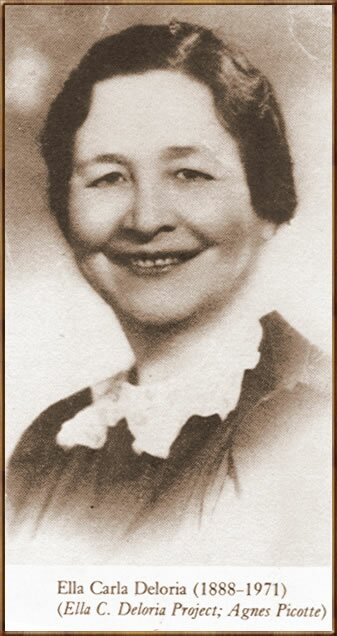
Anpetu Wastewin, from anpetu "day," waste "good," win "woman," was a Yankton Sioux scholar, interpreter, and lecturer who became a nationally famous linguist and ethnologist. She was born January 3, 1888 at Wakpala, South Dakota, the daughter of Reverend and Mrs. Philip Deloria (Tipi Sapa). Her father was an influential Episcopal clergyman who was well known throughout the Plains Indian community in his own right.
Ella attended local schools, then went on to Oberlin College and Columbia University, where she graduated with the B.S. degree in 1915. After graduation she taught school for a brief period, and then became the national Health Education Secretary of Indian Schools conducted by the YWCA. In 1929 she returned to Columbia to begin working with Dr. Franz Boas on a study of the Siouan language; they were her coauthors of two major technical studies of Dakota grammar.
Her first book, Dakota Texts, published in 1932, is still the primary authority on the subject. During this period she wrote for many periodicals, scholarly journals, and lectured widely on Sioux ethnology. In 1944 her book Speaking of Indians appeared, intended primarily for the use of church groups in their missionary work, and included an interest in Indian Culture and customs. Her background in religious work, which she inherited from her parents, was always a major influence in her professional and personal life. In that same year, she was invited to present a major lecture for the American Philosophical Society in Philadelphia-the same organization which had also supported her studies of Dakota Language and social customs.
In later years, Ella Deloria devoted her time to writing, lecturing, and mission school work, most particularly in efforts to record the Dakota language in its most complete form so that it would not join the host of other Native American tongues which have so tragically disappeared into oblivion. From 1955-1958 she was the principal of St. Elizabeth's School at Wakpala, but returned again to her major interest-linguistics-to which she devoted her full energies until she died of pneumonia at the Tripp Nursing Home in Vermillion, South Dakota on February 12, 1971. She left a great archive of Siouan language notes, ethnological observations, and a legacy of devotion to her people which was formalized as the Ella C. Deloria Project at the University of South Dakota, as an ongoing effort to preserve the culture of the Dakota people.


 NATIVE AMERICAN RHYMES