Jay Silverheels
(1912-1980)
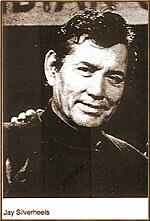
click for a larger image
A popular Native American actor, Jay Silverheels is perhaps best remembered as Tonto, the loyal Indian sidekick to television’s Lone Ranger on the western series that ran from 1949 to 1957. He also performed in a number of films throughout the 1950s, 1960s, and 1970s. The first American Indian to be given a star on Hollywood’s Walk of Fame, he has been credited with contributing to the development of positive images of Native Americans in both television and film.
Silverheels, a full-blooded Mohawk, was born Harold J. Smith on Six Nations Indian Reservation in Ontario, Canada. The Mohawks are a powerful tribe of the Iroquois Confederacy (an alliance of the Mohawk, Seneca, Oneida, Cayuga, and Onondaga formed in about 1570) who still occupy a large reservation in New York State and Ontario. The son of Captain A. G. E. Smith, a decorated Canadian soldier of World War I, Silverheels was a strong athlete. He won early fame in Canada as a champion lacrosse player. He was also skilled in hockey, football, and track, and won several awards in boxing and wrestling.
Silverheels first traveled to the United States in 1938 while playing on Canada’s national lacrosse team. Shortly afterward, he met the actor Joe E. Brown, who launched his acting career. For nine years Silverheels had only minor roles in western films, in which Native Americans were generally portrayed as villains. He had his first important role in 1947 when he played an Aztec warrior in The Captain from Castille. Despite being cast opposite the then famous actor Tyrone Power, Silverheels performed exceptionally well in several scenes, drawing the attention of numerous directors and producers.
In 1949 Silverheels was cast as Tonto in The Lone Ranger television series, an off-shoot of the popular radio program created by Fran Striker in 1933. The role of Tonto was originally played on the screen by the veteran actor Chief Thunder Cloud, a Cherokee. Silverheels made the role fit his own style and became extremely popular in the process. As Tonto, Silverheels—along with Clayton Moore as the masked ranger—fought for law and order in the old American West. It was an unusual example of teamwork between an Indian and a white man in a western drama, as “Tonto and “Kemosabe,” as he called the ranger, often rescued each other from harm. Overall, Silverheels appeared in 221 television installments of The Lone Ranger before the series was cancelled in 1957. Reruns of the program were shown through 1961; afterward, it was widely syndicated (sold directly to local television stations).
Silverheels’s performance as Tonto, as well as his notable performance in The Captain from Castille, greatly contributed to his later success in the film. A tall and handsome man, Silverheels was well liked by American audiences. He was therefore most often cast as a “good Indian,” providing for a sharp contrast to the evil roles usually given to Native Americans in early American film. As a result, Silverheels has been credited, in part, with changing public opinion about American Indians through film.
While Silverheels appeared in many western pictures, a few performances were particularly important to his career. Among these was his 1950 portrayal of the Apache chief Geronimo in Broken Arrow, which is often deemed the first film to depict American Indians in a sympathetic light. In 1964 Silverheels starred in Indian Paint, a film about an Indian boy and his love for his horse, and in 1973 he costarred in Santee, the story of the relationship between a bounty hunter (person who hunts for fugitives to obtain a reward) and the son of a man he killed.
Silverheels also costarred in three Lone Ranger films during this period: Lone Ranger (1956), Lone Ranger and the Lost City of Gold (1958), and Justice of the West (1961). Throughout his career, Silverheels chose nonviolent projects in which American Indians and white people were able to coexist peacefully. Also characteristic of his work is an emphasis on the triumph of good over evil. According to Silverheels, “children had better examples in those days.”
In the 1960s, Silverheels founded and directed the Indian Actors Workshop in Hollywood. Through this workshop, he helped further the acting careers of several Native Americans at a time when roles for them were very limited. Silverheels was also active in numerous public service projects focusing on drug and alcohol abuse and the elderly. On July 21, 1979, he became the first American Indian actor to have a star placed in Hollywood’s Walk of Fame along Hollywood Boulevard.
On March 5, 1980, Silverheels died of complications of pneumonia at the Motion Picture and Television Country House in Woodland Hills, California. At the time of his death, he was survived by his wife, Mary, and four children, Marilyn, Pamela, Karen, and Jay Anthony. Since then, a sports recreation center has been built in his honor on his home reservation in Ontario.
Source: Native North American Biography edited by Sharon Malinowski and Simon Glickman


 NATIVE AMERICAN RHYMES