Pontiac (?-1769)
The name Pontiac is derived from Ottawa obwendiyag, but is of unknown meaning. This Ottawa chief was the leading force behind a coordinated attack on English outposts in the Great Lakes area. Although little is known of his early years, it is believed that he was born of an Ottawa father and Chippewa mother around 1720, along the Maumee River near the mouth of the Auglaize, in Ohio. (Some accounts say the Ottawa River near the Michigan-Ohio boundary.) During Pontiac’s youth, most of the Midwestern tribes sold hides to the French fur traders in the area. The French and Indian relationship was mutually beneficial—the French wanted furs and the Indian wanted arms and other European goods—so both sides were content. But when the English came, they wanted the land, and they took it.
With the defeat of the French following the French and Indian Wars, the British assumed dominance in dealing with frontier Indians. Pontiac’s first experience with them was in 1760 when he was forced to surrender Detroit to the British and retreat into the woods. Pontiac was a natural leader, respected among the Indian people for his eloquence, wisdom, and his achievements as a warrior and military strategist. While at first disposed to be friendly toward the English after their victory in the French and Indian War, their tactless conduct towards him, his increasing sensitivity toward the British ambitions for Indian lands, and, perhaps most importantly, a mistaken belief that the French were about to take up war again, led him to plan an offensive coup.
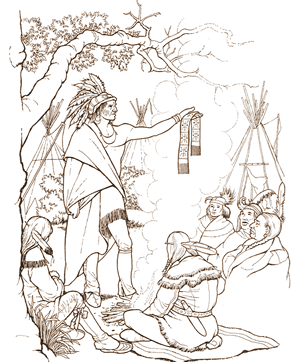
Like many other foresighted Indian leaders, Pontiac’s idea was that the tribes west of the Appalachians should unify, take advantage of the general confusion of the times, and in one surprise attack overwhelm the British forts and settlements. To this end, he sent red wampum belts to all tribes, and received in return indications of encouragement and support. Following a general War Council on April 27, 1763, the alliance was formed, and in May the general attack began. Pontiac and his men entered Fort Detroit wearing blankets to cover their guns and knives; however, the fort commander, Major Henry Gladwin, had been forewarned by a half-breed girl, and the Ottawa found themselves surrounded. They left the fort peaceably, but shortly after, returned and laid siege. They were unable to prevent the fort from being resupplied and the standoff dragged on. Elsewhere, Pontiac’s allies were more successful: in the course of the war, which lasted until the fall of 1764, the Indians captured eight British forts and forced the abandonment of a ninth.
Early reinforcements sent to aid Detroit were defeated, but the Indian alliance began to split up, nevertheless. It became clear that no help could be expected from the French; greater numbers of troops began to come from the East to help the British; and the traditional Indian occupations—hunting and fishing—suffered, greatly affecting native survival. Protracted techniques were contrary to Indian warfare practices.
Finally, with the knowledge that peace had been established between the French and the British in the Louisiana Territory, the disillusioned Pontiac abandoned his siege and withdrew West. His failure to defeat the British diminished his influence, and the Indians perceived that their once great leader had become a liability to their future, since now they had to deal with the Whites, who saw him as a continuing threat. Earlier jealousies and tribal hatreds began to surface again, and on April 20, 1769, while visiting a trading post at Cahokia, Illinois, Pontiac was murdered by a Peoria warrior. The motive for the killing is not known, but it is possible that the British, fearing Pontiac, may have bribed his Indian executioner.
The idea of Indian unity against the White man suffered a setback, but did not die with him. What had started with Popé in 1680 was to be revived again and again all over the country during the next 125 years, to end only with the calumniating tragedy at Wounded Knee in 1890.
Pontiac was tall, powerfully built, with an imposing grace and personality—a man of great eloquence and forthright demeanor. He is known to have had one wife, Kantuckeegan, and at least two sons, Otussa and Shegenaba. His character and abilities have been so strained through historic accounts, some preserving him as an “Indian saint,” and others portraying him as a Machiavellian monster, that we little realize the potential of his skills.
Source: Great North American Indians by Frederick J. Duckstander


 NATIVE AMERICAN RHYMES