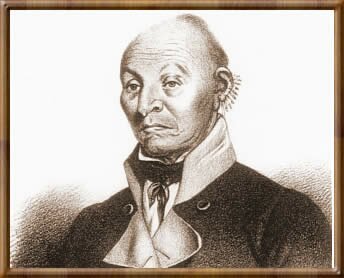
Makataimeshekiakiak, from Sauk makatawi-mishi-kaka, “Big Black Chest,” a reference to the black sparrow hawk, was a Sauk chief who was born in 1767 near present-day Rock Island, in northwest Illinois. His father was Pyesa (or Paisa), a Sauk leader. Famed as a warrior from the age of 15, when he took his first scalp, Black Hawk led early expeditions against the Cherokee and Osage tribes.
In 1804 the Sauk and Fox chiefs ceded all of their lands east of the Mississippi River (about 50,000,000 acres) to the United States for a guaranteed permanent annuity of $1,000 per year. Black Hawk and others repudiated this agreement, saying that the chiefs did not have proper tribal authority; he also charged that William Henry Harrison, the chief negotiator, had seen to it that the chiefs became so intoxicated that they did not realize what they were signing.
In the War of 1812, Black Hawk quickly joined the British side, hoping for Canadian support; while his tribal rival Keokuk remained neutral. Briefly discouraged by his defeats in the War of 1812, Black Hawk then signed the Treaty of 1816 which ratified the sale of Sauk lands, and White settlers began to move in promptly. Keokuk, recognizing the inevitable, moved his own band west of the Mississippi River, but Black Hawk and his followers refused to join them.
As did Tecumseh, Pontiac, and others before him, Black Hawk envisioned a vast confederation of Indian tribes that would be strong enough to withstand the Whites. In an effort to unite the tribes he sent emissaries to all neighboring tribes of the region, and particularly sought the alliance of the Winnebago, Kickapoo, and Potawatomi people; he also tried to involve the British in Canada.
In 1831, when American settlers began to plow up the Sauk lands, Black Hawk urged defiance. Accordingly, the governor of Illinois promptly called out the militia, and the Indians were forced to retreat west of the Mississippi River. In 1832, Black Hawk returned with an estimated 2,000 followers, including at least 500 warriors. He sent envoys under a flag of truce to confer with General Henry Atkinson who led the federal troops which had been summoned. Fearful of treachery, the Illinois regulars shot most of the envoys—and thus brought on the Black Hawk War.
The Indians were initially successful in defeating the federal troops and devastating the frontier settlements. They suffered heavy losses, however, and when help from other tribes was not forthcoming, Black Hawk retreated north through the Rock River Valley, where he sustained a major defeat on July 21. With the survivors, he attempted to cross the Mississippi River at the mouth of the Bad Axe River in Wisconsin, on August 2. Cut off by the steamer Warrior and pursued by Atkinson’s men on land, most of the Indians were slaughtered, drowned, or captured. Black Hawk himself escaped, but subsequently was captured and turned over to the Whites by two Winnebago. He was imprisoned in St. Louis, Missouri and as punishment the Indians were forced to cede their lands in Iowa under the euphemism of “The Black Hawk Purchase” of September 21, 1832.
In 1833, he was freed from prison, and accompanied by Keokuk, was taken east to meet President Andrew Jackson in Washington, after which he toured a number of cities where he was an object of much curiosity; his bearing aroused considerable admiration and sympathy. In that same year he dictated The Autobiography of Black Hawk, which remains a classic statement of Indian life and White confrontation. He died near Iowaville, on the Des Moines River in Iowa on October 3, 1838 at the age of 71. He married once, to Asshewequa (Singing Bird), and had three children: a daughter Nauasia (or Namequa) known to Whites as Nancy; and two sons, Nasheakusk and Nasomsee, known as Tom Black Hawk.
Source: Great North American Indians by Frederick J. Duckstander


 NATIVE AMERICAN RHYMES